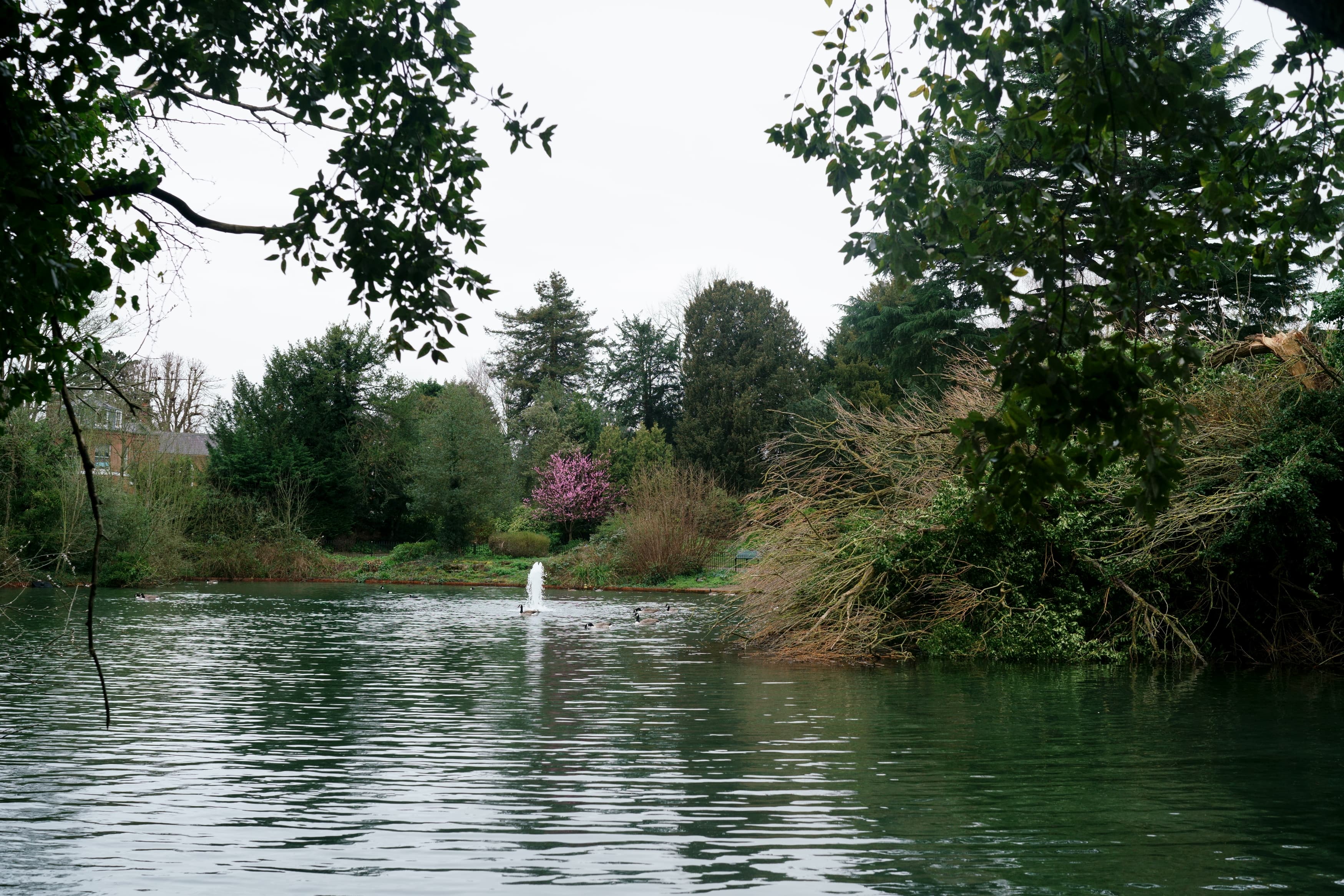
Historic Surrey village with a conservation area, Bourne Hall, two railway stations, and the famous chalk spring that feeds the Hogsmill River.
Ewell is a historic village that forms the eastern half of the Epsom & Ewell borough, retaining a genuinely distinct identity from Epsom town. It has its own conservation area, centred on the village pond and Bourne Hall — a striking circular 1970s building that houses the borough library, museum, and community facilities.
The village has two contrasting centres: the Old Village area around Spring Street and the Pond, with independent shops, pubs, and cafes; and Ewell East's more modern retail offer. Two railway stations serve Ewell: Ewell East (on the line to Epsom and Victoria via Sutton) and Ewell West (on the line to Epsom and Waterloo).
The Spring is one of Surrey's most distinctive natural features — a chalk spring rising in the grounds of Bourne Hall that feeds the Hogsmill River, which flows north from Ewell through Kingston to the Thames. Millais is said to have painted part of his famous Ophelia in the meadows near the Hogsmill.
Ewell is popular with families for its good schools, green spaces, and the walking route along the Hogsmill towards Kingston. The village maintains a community feel despite being effectively contiguous with Epsom to the west and the outer London suburbs to the north.